Frei aber froh, Marlboro Musicians at Weill Recital Hall

Brahms’s Clarinet Quintet, Maria Ioudenitch, 1st Violin, Stephanie Zyzak, 2nd Violin, Hiroki Kasai, Viola, Peter Stumpf, Cello [/caption]
Frei aber froh, Marlboro Musicians at New York on 2.21.2025. Young and veteran musicians who participated in the Chamber Music Festival in Summer Marlboro, Vermont, held a recital at Weill Recital Hall in Carnegie Hall. The opening piece, Schumann's Fairy Tale, written in 1853, the year before Schumann attempted suicide due to mental health issues, features the clarinet's warm, gentle staccato and breezy trills, the viola sounding like insects calling, and the piano's tone evoking a fortepiano, much like the pastoral sound of Marlboro. Kurtág's Homage to Schumann (1990) depicts Schumann's two personalities, Eusebius and Florestan, who were schizophrenic, and the same piano, viola, and clarinet trio performs an entirely different piece that connects irregularly with vague legato. It's like gazing silently at the sunlight streaming in through the window, reflected on the wall. Suddenly, a loud commotion erupts, overturning the carefully arranged items on the table—Schumann's Florestan.
Lips trembling, intense excitement. A stunning, inorganic yet delicate soundscape for just under 10 minutes. Nothing crossed my mind. I enjoyed the distorted, instinctive soundscape against the steady piano tempo. In Schumann's String Quartet No. 2, four different musicians played. In the first movement, two violins exchanged a theme, followed by an enchanting andante, an athletic scherzo, and a bouncy dance. The last piece was Brahms's clarinet quintet, 50 years after Schumann's string quartet. It has five movements and lasts 30 minutes. The first violin, Maria Ioudenitch's profound lyricism on a fresh and large scale, like a mountain stream flowing down the slope. Her muted voice on Adagio reminded me of Tchaikovsky's concerto. I checked her schedule and found Tchaikovsky's concerto on it. Through her rich, fresh performances, I felt the deep, rich musicality and pure vitality of her Russian blood. They saw possibilities, new beginnings, and connections, cultivated perspectives across ages and ethnicities, and freely pursued and conveyed what they found most meaningful and beautiful in music.
バーモント州の田舎町、マルボロで7月から8月に開催される室内音楽祭に参加した若いプロフェッショナルとベテランの音楽家がカーネギーホールにあるワイル・リサイタルホールで2月21日に演奏会を行った。冒頭のシューマンのおとぎ話では、ほのぼのとしたクラリネットの柔らかなスタッカート、そよ風のトリル。ビオラの刻みは虫の鳴き声に聴こえピアノの音色はまるでフォルテピアノのように風情ある演奏を披露するとそこはまるでマルボロだった。この曲はシューマンが精神障害で自殺を試みる前年の1853年に書かれている。続くクルタークのシューマンへのオマージュ(1990年)は、分裂症害を患っていたシューマンの2つの人格、オイゼビウスとフロレスタンが描かれていて、同じピアノ、ビオラ、クラリネットのトリオが一変した演奏を繰り広げる。ぼんやりとレガートで不規則につながるクラリネット、ピアノ、ビオラ。壁に映った窓から差し込む日差しを無音で眺めているようだ。突然、丁寧にテーブルの上に並べられたものをひっくり返すような激しい喧騒。シューマンのフロレスタン。唇が震え激しく興奮している。10分弱の無機質で繊細な見事な音の空間芸術。頭には何もよぎらずピアノの安定したテンポの中で彼らが醸し出すいびつで本能的な音の空間を楽しんだ。シューマンの弦楽四重奏曲2番では別な4人のアンサンブル。1楽章で陽気に1つの主題を2つのバイオリンが掛け合う。うっとりするアンダンテ、アスレチックなスケルツォ、そして飛び跳ねるような舞曲。最後はシューマンの弦楽四重奏から50年後のブラームスが描いたクラリネット5重奏。5楽章からなり演奏時間は30分に及ぶ。マリア・ユデニッチの第一バイオリンはまるで山の斜面を流れる渓流のようにブラームスの深い抒情性を瑞々しく大きなスケールで奏でていく。アダージョのミュートをかけソロで主旋律を歌う様子にすぐにチャイコフスキーの協奏曲を思い浮かべ、後で彼女のスケジュールを調べてみると、チャイコフスキーの協奏曲を演奏していた。彼女に流れるロシアの血で奏でる深く豊かな音楽性を感じた。クラリネットのキム・サンユンは、シューマンの牧歌的な幻想、クルタークの精神障害、ブラームスの深い抒情性をそれぞれ見事に演奏した。マルボロの室内楽コンサートでは作品ごとの純粋な生命力を豊で新鮮な演奏で堪能できる。彼らはマルボロに可能性や新たな始まりとつながりを見出し、年齢や民族を超えた視点を育み、音楽の中で最も意義深く美しいと思うことを自由に追求し伝えていたといえる。一言で言うと、複数のソロを同時に聴いている気分。よく言えば斬新、で逆はバランスがめちゃくちゃ悪い。
Friday, February 21, 2025
Artists
Sang Yoon Kim, Clarinet
Maria Ioudenitch, Violin
Stephanie Zyzak, Violin
Hiroki Kasai, Viola
Natalie Loughran, Viola
Peter Stumpf, Cello
Evren Ozel, Piano
Program
ROBERT SCHUMANN (1810-1856)
Märchenerzählungen [Fairy Tales], Op. 132 (1853)
1.Lebhaft, nicht zu schnell
2.Lebhaft und sehr markirt
3.Ruhiges Tempo, mit zartem Ausdruck
4.Lebhaft, sehr markirt
Sang Yoon Kim, Natalie Loughran, Evren Ozel
GYÖRGY KURTÁG (B. 1926)
Hommage à R. Sch., Op. 15/d (1990)
1. (merkwürdige Pirouetten des Kapellmeisters Johannes Kreisler): Vivo [(remarkable pirouettes of music-master Johannes Kreisler)]
2. (E.*: der begrenzte Kreis ...): Molto semplice, piano e legato [*E. = Eusebius] [(Eusebius: the perfect circle...)]
3. (... und wieder zuckt es schmerzlich F.* um die Lippen...): Feroce, agitato
[*F. = Florestan]
[(.. and again there is a painful twitching about Florestan's lips...)]
4. (Felhő valék, már süt a nap...) (töredék-töredék): Calmo, scorrevole
[(The clouds are gone, the sun is already shining...) (Fragment-Fragment)]
5. In der Nacht: Presto
[In the night]
6. Abschied (Meister Raro entdeckt Guillaume de Machaut): Adagio, poco andante [Farewell (Master Raro discovers Guillaume de Machaut)]
Sang Yoon Kim, Natalie Loughran, Evren Ozel
R. SCHUMANN String Quartet in F Major, Op. 41, No. 2
BRAHMS Clarinet Quintet in B Minor, Op. 115
ロベルト・シューマン(1810-1856)
おとぎ話 Op. 132(1853)
活発だが、速すぎない
生き生きとしていてとても特徴的
穏やかなテンポ、繊細な表現
生き生きとした、非常に際立った
ジェルジ・クルターグ(1926年生まれ)
オマージュ・ア・R. Sch.、作品番号15/日 (1990)
1. (音楽の巨匠ヨハネス・クライスラーの見事なピルエット): Vivo [(音楽の巨匠ヨハネス・クライスラーの見事なピルエット)]
2. (E.*: 限られた円...): 非常にシンプル、ピアノとレガート [*E. = エウセビウス] [(エウセビウス: 完全な円...)]
3. (...そして再びF.*の唇が痛々しく痙攣する...): 激しく、興奮して
[*F. = フロレスタン]
[(...そして再びフロレスタンの唇が痛々しく痙攣する...)]
4. (雨が降って、とても疲れた...) (ゆっくり静かに): 落ち着いて、落ち着いて
【(雲は消え、太陽はもう輝いている…)(断片-断片)】
5. 夜の中で: プレスト
【夜】
6. 別れ(ラロ師匠がギヨーム・ド・マショーを発見):アダージョ、ポコ・アンダンテ [別れ(ラロ師匠がギヨーム・ド・マショーを発見)]
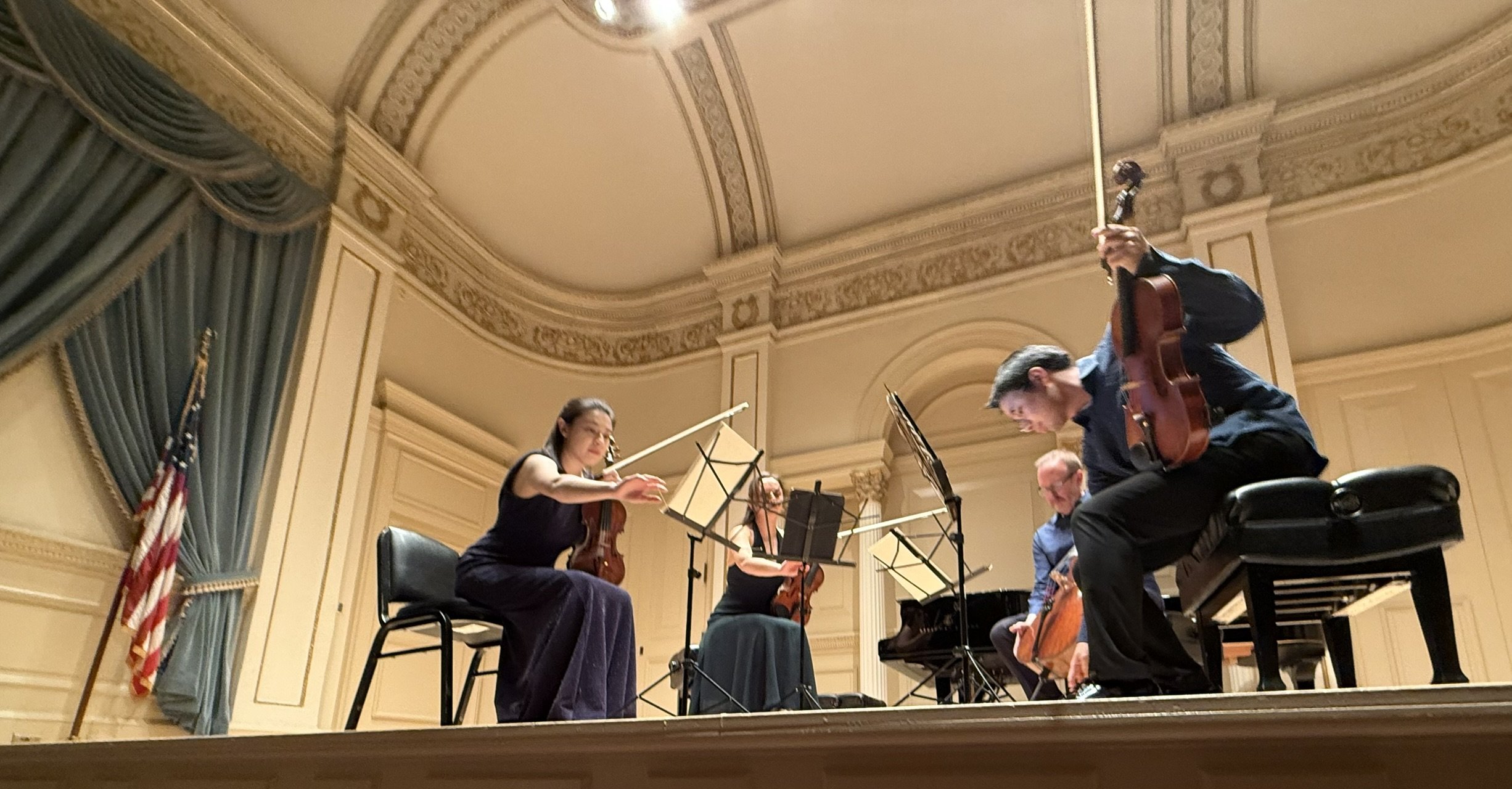
Schumann’s Op41-2
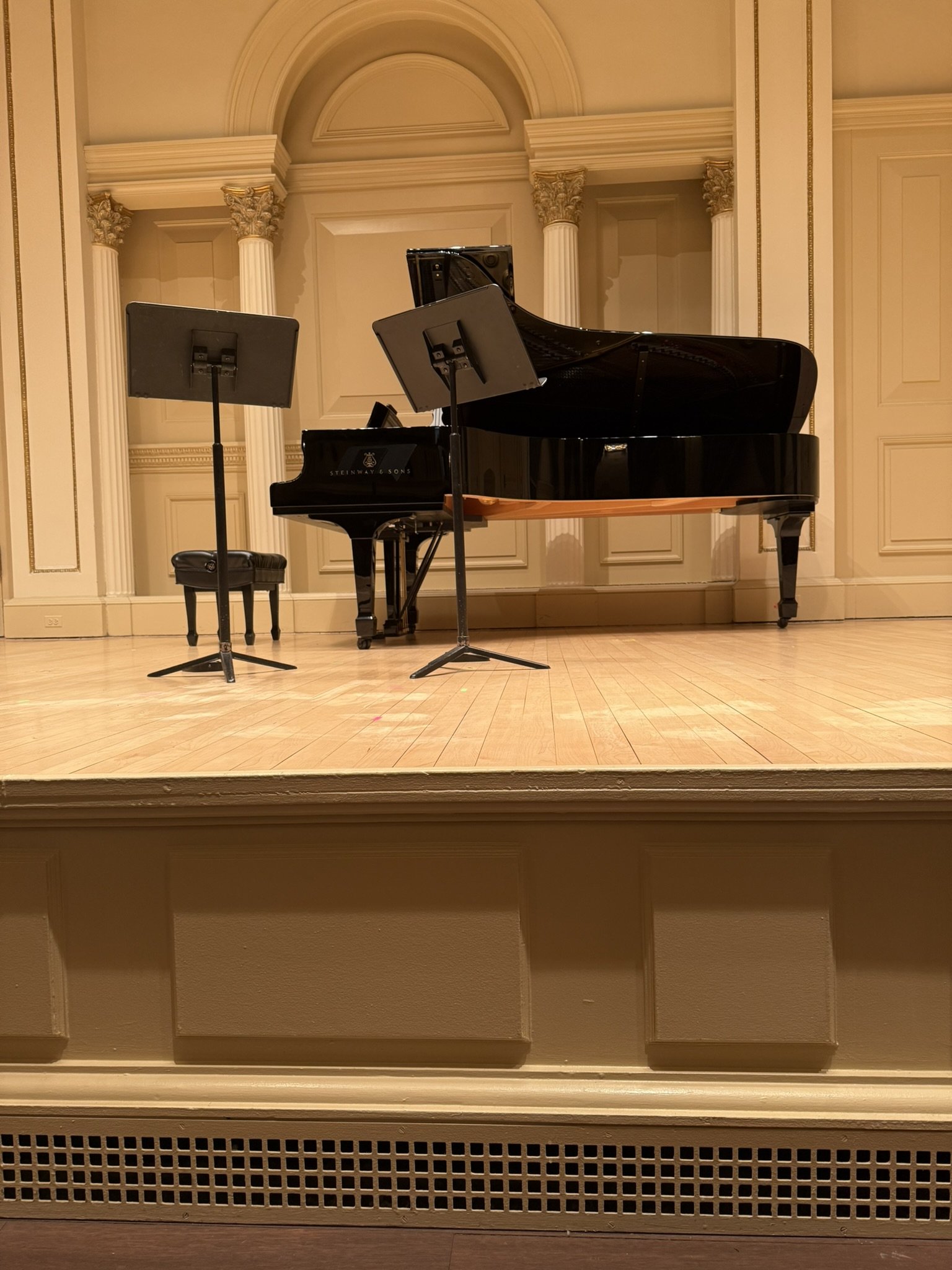
1st half setting [/caption] [caption id="" align="alignnone" width="1536"]
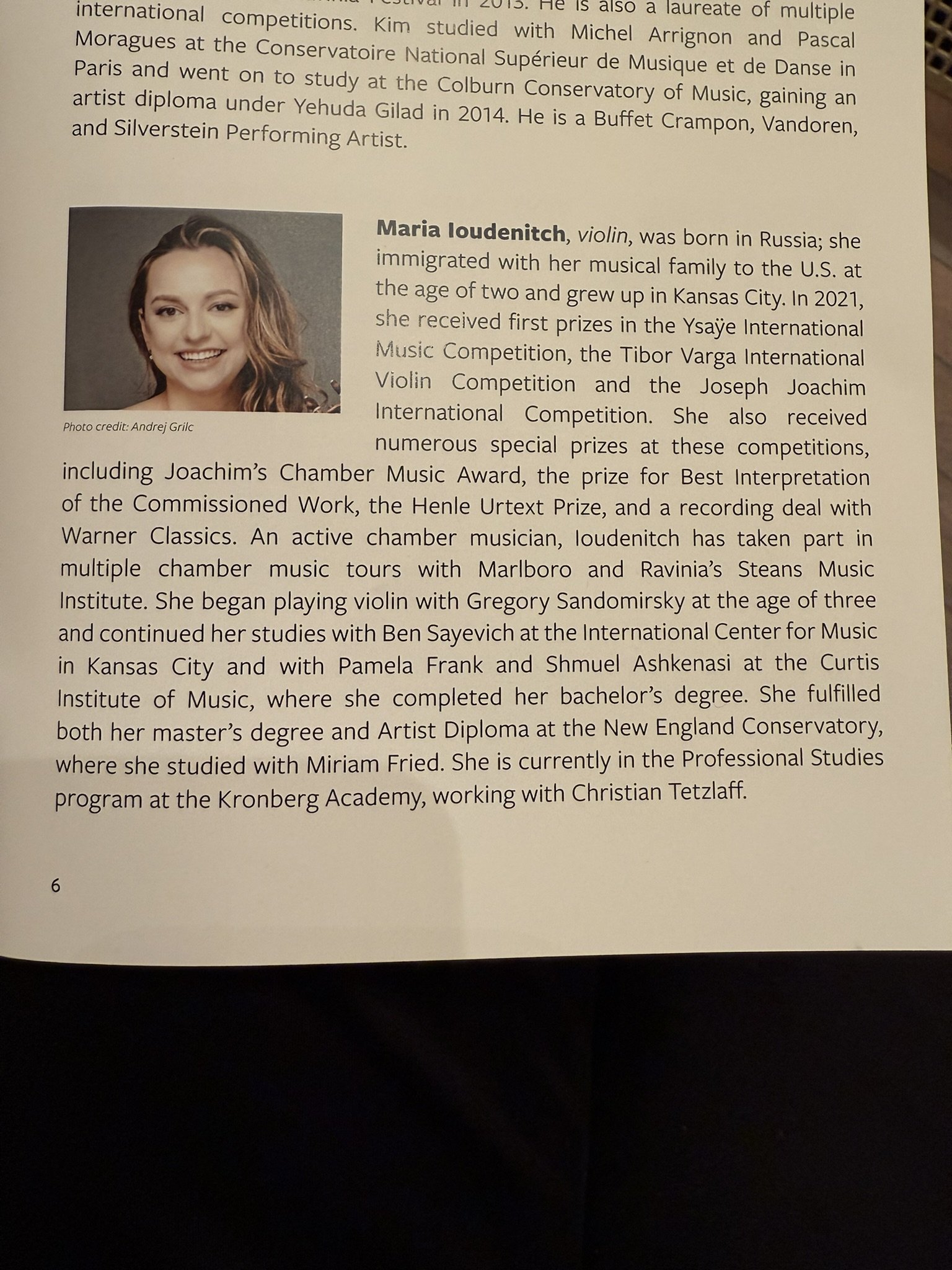
Wish she connect Russian musican and music that I miss after Ukrein war [/caption] [caption id="" align="alignnone" width="3024"]
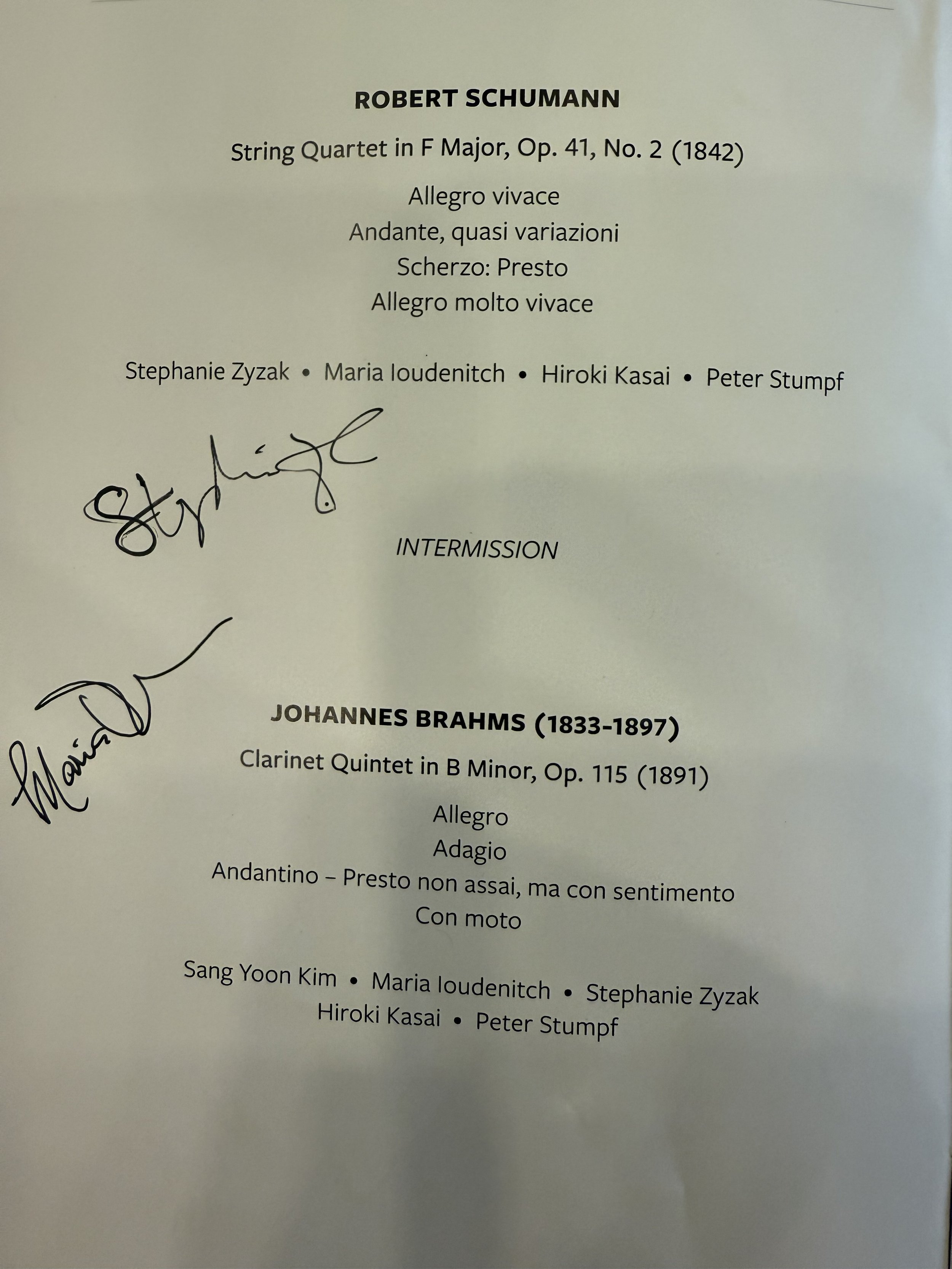
Stephanie and Maria’s autographs [/caption]
Comments ()