Talea SYNCHRONISM
When Live Sound Meets Electronic Sound — Davidovsky × Talea Ensemble
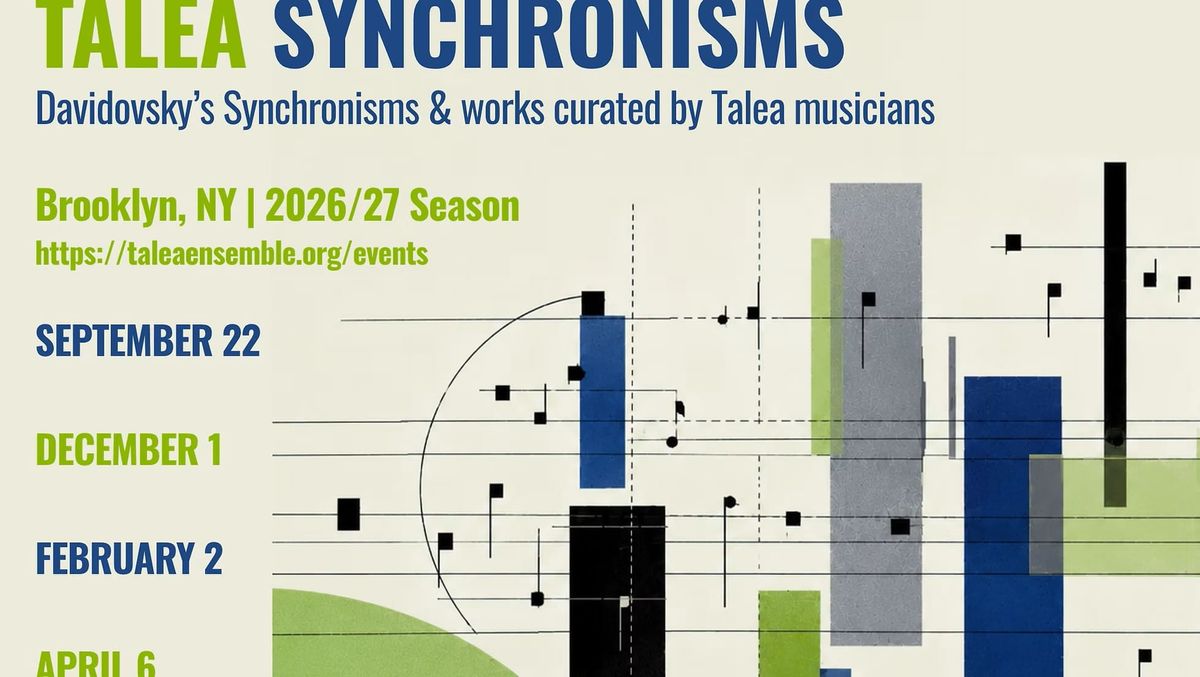
Talea Ensemble’s “SYNCHRONISMS” series begins in September. Centered on the works of Davidovsky, the series brings together music from different periods and composers, extending this idea into the contemporary performance space. The first program features works by Gubaidulina and Beethoven alongside Davidovsky’s Synchronisms No. 6 and Synchronisms No. 11. Synchronisms No. 6 is written for piano and electronic sounds, while Synchronisms No. 11 is for double bass and electronic sounds. The relationship Davidovsky explored from the 1960s onward—between live instruments and electronic sounds, and between time generated by the human body and fixed time—continues today in New York through new performances.
Talea SYNCHRONISMS I
Sep 22, 2026, 7:30 PM
Church of St. Luke & St. Matthew, 520 Clinton Ave, Brooklyn, NY 11238, USA
Curated by Greg Chudzik (bass) & Steve Beck (piano) and inspired by Mario Davidovsky’s Synchronisms
PROGRAM:
Sofia Gubaidulina (1931 - 2025) - Sonata for Double Bass and Piano (1975)
Mario Davidovsky (1934 - 2019) - Synchronisms No. 6 for Piano and Electronic Sounds (1970)
Ludwig van Beethoven (1770 - 1827) - Romance No. 2, Op. 50 (1798)
Mario Davidovsky (1934 - 2019) - Synchronisms No. 11 for Double Bass and Electronic Sounds (2005)
Mario Davidovsky (1934–2019) was born in Mendoza, Argentina. He began studying music as a child, started composing in his teens, and moved to the United States in the 1950s, eventually establishing New York as his base. In New York during the 1950s and 1960s, new possibilities in music were opening through tape and electronic sound. Davidovsky became involved with the Columbia-Princeton Electronic Music Center, where he explored the relationship between electronic sound and sounds produced through the human body. How could electronic sound be connected to sound generated by the human body? The flute, violin, and piano breathe, move, and produce sound in the moment. Tape-recorded electronic sound, on the other hand, already exists within a fixed span of time. What happens when these two are placed in the same space?
Davidovsky, who was creating electronic music, met the flutist Harvey Sollberger, who was also exploring new techniques in contemporary music. Sollberger drew a wide range of timbres and resonances from the flute, expanding the instrument's possibilities in contemporary music. Davidovsky explored the possibilities of sound in the electronic music studio, while Sollberger expanded the flute's possibilities through performance. As these two directions came together, a new form of music emerged: Synchronisms. The first work in the series, Synchronisms No. 1, was premiered in 1963.
Synchronisms No. 1 is written for flute and electronic sounds. Davidovsky places the flute and electronic sounds within a single musical relationship, allowing each to transform the other. Flutter-tonguing on the flute leads into continuous electronic sounds, while clicks and pops on the tape are answered by flute key sounds and accents. The two sounds give each other movement as the music unfolds. The tape moves through time at a predetermined speed, while the flutist breathes and produces sound in the moment. Two beings with different kinds of time meet within a single piece of music, creating a distinctive sonic space in which the flute and electronic sounds overlap.
What happens in this work is that the flute has a time that emerges in the moment through the performer’s breath and finger movements. The electronic sounds have a time that has already been recorded. These two times overlap within the same piece of music, allowing the listener to sense different movements of time within a single musical space. This overlapping of time turns the ear toward how the flute and electronic sounds affect one another and how they change. From distinguishing individual sounds to listening to the relationships between sounds. Sound emerges, changes, and connects to another sound. Synchronisms No. 1 embodies Davidovsky’s idea of Synchronisms: “To make two beings with different kinds of time into a single piece of music.”
生の音と電子音が出会うとき――Davidovsky × Talea Ensemble
Talea Ensembleによる「SYNCHRONISMS」のシリーズが9月から始まる。Davidovskyの作品を中心に、異なる時代や作曲家の音楽を組み合わせ、このアイデアを現代の演奏空間へ広げていく。1回目はGubaidulinaやBeethovenの作品とともに、Davidovskyの《Synchronisms No. 6》と《Synchronisms No. 11》が演奏される。《Synchronisms No. 6》はピアノと電子音、《Synchronisms No. 11》はコントラバスと電子音のための作品である。1960年代からDavidovskyが探究してきた、生の楽器と電子音、身体から生まれる時間と固定された時間の関係が、現在のニューヨークでも新たな演奏を通して受け継がれている。
Mario Davidovsky(マリオ・ダヴィドフスキー)は、1934年、アルゼンチンのメンドーサに生まれた。幼い頃から音楽を学び、10代の頃には作曲を始め、1950年代にアメリカへ渡り、ニューヨークを拠点に活動するようになった。1950年代から60年代のニューヨークでは、テープや電子音響など、新しい音楽の可能性が広がっていた。DavidovskyはColumbia-Princeton Electronic Music Centerに関わり、電子音響と人間が身体を使って生み出す音との関係を探究する。電子音響と、人間の身体から生まれる音をどう結びつけることができるのか。フルート、ヴァイオリン、ピアノが、その場で息をし、指を動かし、音を生み出す。一方、テープに記録された電子音は、すでに固定された時間の中にある。この二つを同じ空間に置いたとき、何が起こるのか。
電子音楽を作っていたDavidovskyと、現代音楽の新しい奏法にも取り組んでいたフルート奏者Harvey Sollbergerが出会い、Sollbergerはフルートからさまざまな音色や響きを引き出し、現代音楽における楽器の可能性を広げていた。電子音響のスタジオで音の可能性を探究していたDavidovskyと、演奏を通してフルートの可能性を広げていたSollberger。この二つの方向が出会うことで、《Synchronisms》という新しい音楽の形が生まれていく。その最初の作品が、1963年に初演された《Synchronisms No. 1》である。Davidovskyは、フルートと電子音を一つの音楽的な関係の中に置き、互いの音を変化させる。フルートのフラッタータンギングが電子音の連続へつながり、テープのクリックやポップにフルートのキーを叩く音やアクセントが応答する。二つの音が互いに動きを与えながら、音楽が進んでいく。テープは決められた速度で時間を進み、フルート奏者はその場で呼吸し、音を生み出す。そこには、異なる時間を持つ二つの存在が、一つの音楽の中で出会い、フルートと電子音が重なり合う独自の音響空間が生まれる。
この作品で起きているのは、フルートには、演奏者の呼吸や指の動きによって、その瞬間に生まれる時間がある。電子音には、あらかじめ記録された時間がある。その二つの時間が同じ音楽の中で重なり、聴き手は一つの音楽の中に異なる時間の動きを感じる。その時間の重なりは、フルートと電子音が影響し合い、どのように変化していくのかへ耳が向いていく。一つひとつの音を聴き分けることから、音と音の関係を聴くことへ。音が生まれ、変化し、別の音へとつながっていく。《Synchronisms No. 1》は、「異なる時間を持つ二つの存在を、一つの音楽にする。」それが、Davidovskyにとっての《Synchronisms》というアイデアだった。
Comments ()