How Long Can We Listen? Feldman’s For Christian Wolff
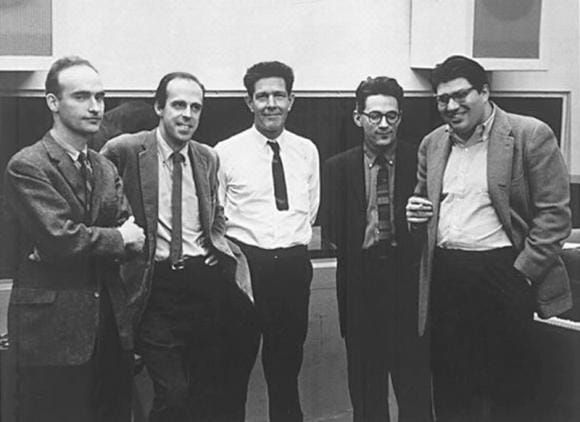
《For Christian Wolff》, performed at Mise-en-Place on October 6, was written in 1986 as a late major work for Christian Wolff, Feldman’s longtime friend and fellow member of the New York School. Wolff studied with John Cage and, together with Feldman and Brown, pursued new possibilities beyond traditional music in which the composer determines everything, exploring greater freedom for performers and the possibility of creating music through attentive listening between performers. For Feldman, Wolff was more than a fellow composer of his generation; he was a lifelong friend who shared a deep understanding of music.
This performance is part of “Feldman & Brown at 100,” a celebration of Morton Feldman’s 100th birthday curated by Steve Long (Crazy Guy). The festival celebrates Feldman and Earle Brown, two central figures of the postwar New York art movement known as the New York School. Running for roughly three months through mid-November at venues across New York City, the festival brings together 17 concerts, talks, and special events exploring the worlds of two composers who profoundly changed 20th-century music.
Their relationship also took the form of musical responses to one another. Feldman wrote 《Christian Wolff in Cambridge》 in 1963 and later 《For Christian Wolff》. After Feldman died in 1987, Wolff wrote 《For Morty》 the following year, using Feldman’s nickname as its title. Beyond the larger artistic movement of the New York School, the two had built a personal trust over many years.
《For Christian Wolff》 can be heard as a monument to that friendship, but when listening to the work itself, what emerges is the extreme sense of time Feldman pursued in his later years. The sounds are quiet, and a large space separates one sound from the next. A sound appears, remains, and disappears. As we follow these subtle changes, our own sense of time gradually begins to shift. This is not music in which one thing happens after another, but music in which we listen to the time in which a single sound exists.
The flutist, Roberta Michel, is a Brooklyn-based flutist who has devoted her career to contemporary music. She has commissioned and premiered hundreds of new works and is the Co-Director of Wavefield Ensemble, as well as a member of Da Capo Chamber Players, PinkNoise, and Duo RoMi. Her solo album 《Hush》 explores the possibilities of the flute, while her doctoral research focused on Salvatore Sciarrino's flute music. Her musical practice explores the flute through breath, minute sounds, noise, and the boundary between sound and silence, closely connecting with Feldman’s delicate sound world.
Pianist Matt Mitchell is a New York-based pianist and composer whose work spans jazz, improvisation, and contemporary composition. He has performed extensively with creative musicians including Tim Berne, Dave Douglas, John Hollenbeck, Anna Webber, and Ches Smith. With a background in both composition and improvisation, Mitchell approaches Feldman’s score not simply as something to reproduce, but as music to be shaped through listening to the relationships between individual sounds and their passage through time.
Through Michel’s flute and Mitchell’s piano, we will hear how the relationship between sound and silence, sound and space, and sound and time takes shape. 《For Christian Wolff》 offers an experience of the question Feldman arrived at in his later years: not what happens, but how long and how deeply can we listen to a single sound?
Concerts at Mise-en Place
Tuesday, October 6
Doors 6:30 PM • Music 7:00 PM
For Christian Wolff by Morton Feldman
Mise-en-Place, New York, NY
Roberta Michel (flute) and Matt Mitchell (piano) perform Feldman's For Christian Wolff
Written for one of Feldman's closest colleagues in the New York School, this late work unfolds with extraordinary patience and precision. Its expansive scale rewards deep listening, revealing an astonishing richness within the smallest musical gestures.
Tuesday, October 27
Doors 7:00 PM • Music 7:30 PM
Short solo and chamber works by Feldman and Brown
Mise-en-Place, New York, NY
An intimate evening of concise masterworks showcasing the remarkable range of Morton Feldman and Earle Brown's musical imagination. From Feldman's exquisitely distilled miniatures to Brown's pioneering open-form compositions, joined by a rare work by Stefan Wolpe, this program traces chamber music's radical reinvention in postwar New York.
フェルドマンの友達。長く聴く。
10.6.2026 この公演は、スティーブ・ロングがキュレートしたMorton Feldmanの生誕100年を記念する「Feldman & Brown at 100」の一環として行われる。戦後ニューヨークの芸術運動「New York School」の中心にいたFeldmanとEarle Brownの生誕100年を祝うこのフェスティバルは、11月中旬までニューヨーク各地で約3か月にわたって開催され、17のコンサート、トーク、特別イベントを通して、20世紀の音楽を大きく変えた二人の世界を探っていく。
10月6日にMise-en_Placeで演奏される《For Christian Wolff》は、1986年、Feldmanが長年の友人であり、New York Schoolをともに形成した作曲家Christian Wolffのために書いた晩年の大作である。WolffはJohn Cageに師事し、FeldmanやBrownとともに、作曲家がすべてを決める従来の音楽から離れ、演奏者の自由や、演奏者同士が互いの音を聴きながら音楽を作る可能性を追求した。FeldmanにとってWolffは、単なる同時代の作曲家ではなく、音楽について深く理解し合う生涯の友だった。
二人の関係は、作品を通して互いに応答するようなものでもあった。Feldmanは1963年に《Christian Wolff in Cambridge》を書き、晩年には《For Christian Wolff》を残した。Feldmanが1987年に亡くなると、Wolffはその翌年、友人の愛称をタイトルにした《For Morty》を書いた。New York Schoolという大きな芸術運動の中で出会った二人の間には、長い時間をかけて築かれた個人的な信頼があった。
《For Christian Wolff》をその友情の記念碑として聴くこともできるが、作品そのものに耳を向けると、そこにあるのはFeldmanが晩年に追求した極端に長い時間である。音は小さく、音と音の間には大きな空間がある。一つの音が現れ、残り、消えていく。そのわずかな変化を追っているうちに、聴く側の時間の感覚も少しずつ変わっていく。何かが次々に起こる音楽ではなく、一つの音が存在している時間を聴く音楽である。
今回フルートを演奏するRoberta Michelは、現代音楽を活動の中心に据えてきたブルックリンのフルート奏者である。これまでに何百もの新作を委嘱・初演し、Wavefield Ensembleの共同ディレクターを務めるほか、Da Capo Chamber Players、PinkNoise、Duo RoMiなどで活動している。ソロ・アルバム《Hush》ではフルートの可能性を掘り下げ、博士論文ではSalvatore Sciarrinoのフルート音楽を研究した。息、微細な音、ノイズ、音と沈黙の境界まで含めてフルートの可能性を探ってきた彼女の音楽性は、Feldmanの繊細な音の世界と深く重なる。
ピアノを演奏するMatt Mitchellは、ジャズ、即興音楽、現代作曲を横断して活動するニューヨークのピアニスト、作曲家である。Tim Berne、Dave Douglas、John Hollenbeck、Anna Webber、Ches Smithなど、現代の創造的な音楽家たちと数多く共演してきた。作曲と即興の両方を背景に持つMitchellにとって、Feldmanの楽譜も単に再現するものではなく、一つ一つの音の関係と時間を聴きながら組み立てていく音楽になるだろう。
MichelのフルートとMitchellのピアノによって、音と沈黙、音と空間、そして音と時間の関係がどのように立ち上がるのか。《For Christian Wolff》は、Feldmanが晩年にたどり着いた「何が起こるか」ではなく、一つの音をどこまで長く、深く聴くことができるかという問いを体験する作品になる。
Comments ()