Kaleidoscopic Leif Ove Andsnes at Carnegie
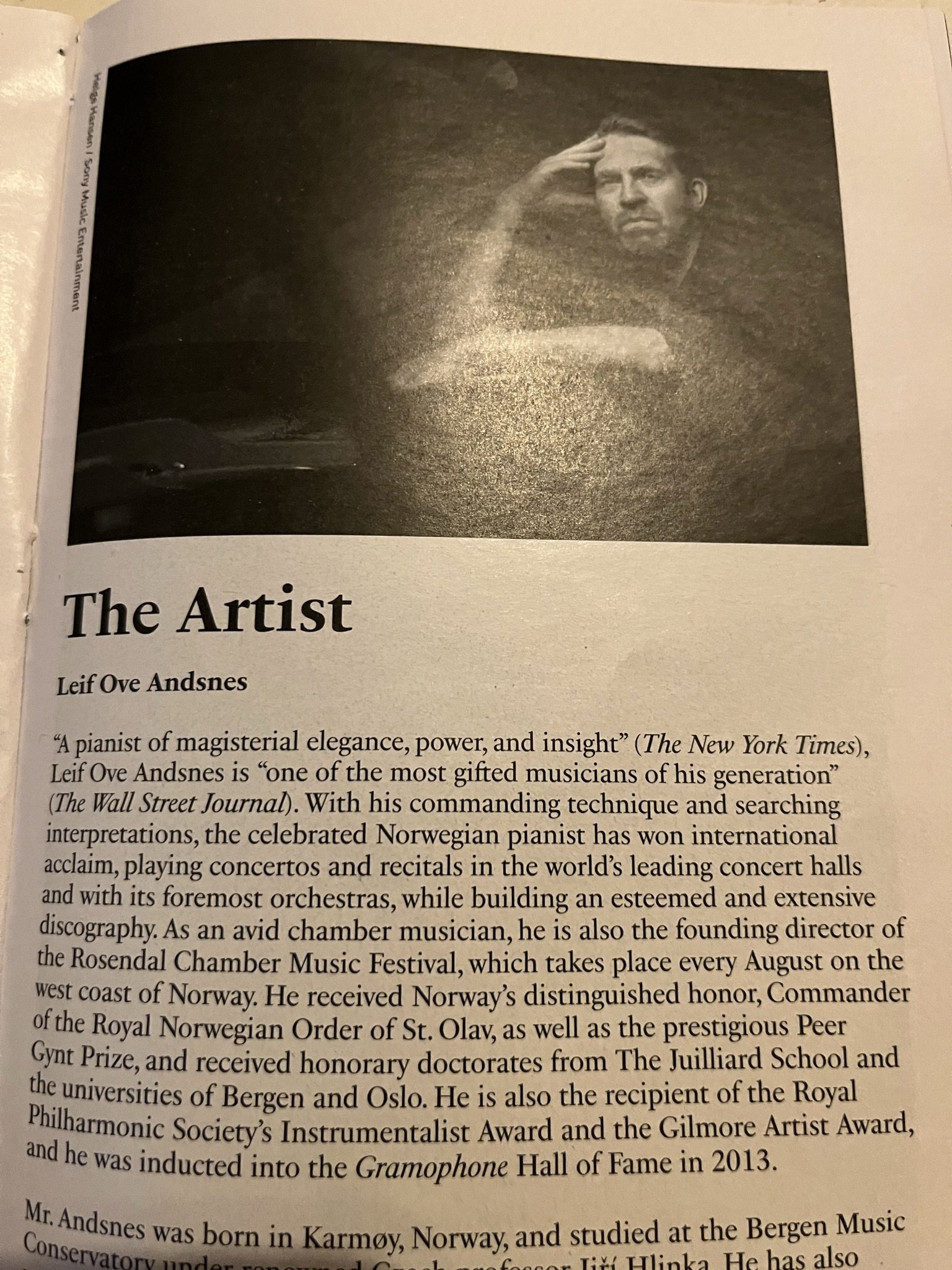
If one can find a relevant conversation with the music that we do and what is going on with the world, it’s wonderful, but I wouldn’t want to always look for something. It can be fabricated.
by Andsnes
Leif Ove Andsnes has been familiar with Dvořák’s works since he was a child, as his father’s collection included one of the few available recordings. However, he only began studying them in depth during the time afforded by the pandemic. What makes this cycle so compelling is the mix of deeply spiritual pieces, like “In the Old Castle” and “Twilight Way,” alongside everyday depictions in “Toying” and “Tittle-Tattle.” As in Pictures at an Exhibition or late Beethoven, moments of ordinary life come vividly to life. While Dvořák is sometimes overshadowed by his contemporary and admirer Brahms—whose music features clear counterpoint and dense voices—these subtleties in Dvořák can be brought out depending on the performer. In difficult times, audiences often turn to Beethoven, whose music carries the sense of struggle, fight, and the search for resolution or victory.
At Carnegie Hall, Andsnes’ recital through Tuesday evening was dreamily kaleidoscopic. Folk-like melodies, solemn marches, and sentimental dances flowed seamlessly. In Vustin’s Lamento—by the Russian composer thought to have died from COVID-19 complications early in the pandemic—Andsnes’ left hand quietly articulated shifting chords, while the right hand, more angular and unpredictable, entered with trills and atonal flourishes, as if fervent ideas were held back from full expression. By the end, only whispering chords remained, naturally leading into the quiet, anguished opening of Janáček’s sonata 1.X.1905 “From the Street”, written in memory of a 20-year-old Czech worker killed—pointlessly, Janáček believed—by a German soldier during a political demonstration. The emotional essence of Lamento seemed to resurface in waves of mournful lyricism and anger.
Following that, works by Valentin Silvestrov, Ukraine’s foremost composer, were performed. As in many of Silvestrov’s pieces, the insistent serenity that followed Janáček’s sonata came across as a plea for beauty, if not for peace. From the first piece of Dvořák’s Poetic Tone Pictures, “Twilight Way,” Andsnes guided the score masterfully, never losing sight of its sometimes obscured melodic lines and controlling its technically challenging articulations. He highlighted the reverent dignity of “In the Old Castle,” the sweet, I-could-have-danced-all-night quality of “Furiant,” and the shards of light piercing through the chorale in “On the Holy Mountain.”
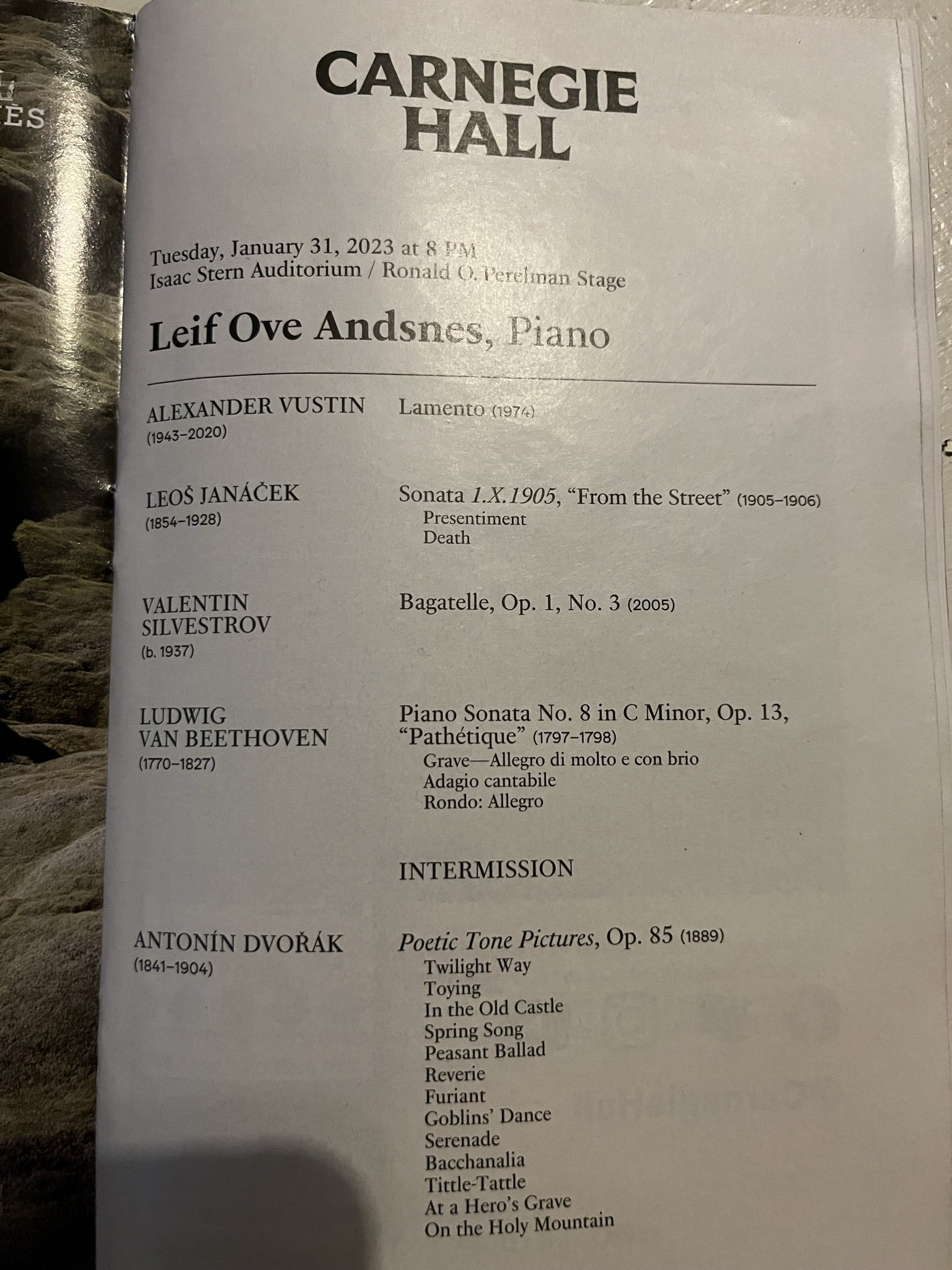
VUSTIN Lamento
JANÁČEK Sonata 1.X.1905, "From the Street"
VALENTIN SILVESTROV Bagatelle, Op. 1, No. 3
BEETHOVEN Piano Sonata No. 8 in C Minor, Op. 13, "Pathétique"
DVOŘÁK Poetic Tone Pictures, Op. 85
Detail and From the program note
At once dramatic and hauntingly atmospheric, is typical of Vustin’s richly evocative soundscapes: a flighty, clangorous melody, replete with angular leaps and flowing roulades, stands out in sharp relief against an undertow of softly pulsating chords, creating a tension that the final, lingering consonance fails to resolve.
The composer seems to have harbored a death wish for his own creation: He burned the original finale just before the premiere, and later tried to drown the remaining two movements in the Vltava River.
The two movements are united by their elegiac mood and somber E-flat–minor tonality. “Presentiment” opens with a tender, plangent melody.
“Death” is by turns serene and agitated, its hollow octaves and irregular rhythms conveying a sense of resignation and anguish.
Like walking through a forest, light shining through the boughs
Silvestrov’s deceptively simple miniatures is a poetic essay in easy-on-the-ear tonal harmonies, delicate, pointillistic patterns, and lingering resonances.
“A remembrance of things past” Silvestrov’s Prayer for Ukraine
LUDWIG VAN BEETHOVEN
Piano Sonata No. 8 in C Minor, Op. 13, “Pathétique”
Approach to the keyboard, which wreaked havoc on the light-framed fortepianos of the day
“greater eloquence, weightier ideas, and is more expressive—in short, he is more for the heart.”
Crazy music, in opposition to all rule
In them found a solace and a delight such as no other composer afforded me.
ANTONÍN DVOŘÁK
Poetic Tone Pictures, Op. 85
About Pianist
‘The Great Czech Piano Cycle’ Arrives at Carnegie Hall
By David Allen
Jan. 29, 2023
Andsnes has known the work since he was a boy; his father had one of its few recordings in his collection. But he came to study it properly only in the time afforded by the pandemic.
A picture of Czech life. What I love about the cycle is, you have very spiritual pieces, the mystery of “The Old Castle” and “Twilight Way,” and on the other hand you have a piece called “Toying.” Another piece is called “Tittle-Tattle.” It’s everyday life, which you also have in “Pictures at an Exhibition,” or even in late Beethoven.
Dvorak always suffers a bit in comparison with Brahms, because they were contemporaries and admired each other. Brahms has this obvious counterpoint and resistance in the music; we always feel that every voice is so rich. Dvořák doesn’t have that, and the music can feel a little too easy to swallow. It depends on the performer to bring out all these subtleties.
And in grim times, we often turn to Beethoven.
So often, there is a feeling of struggle or fight in Beethoven’s music —trying to find solutions, answers, or victory, somehow.
Comments ()